The Third Place Problem: Why So Many Americans Are Finding Their People at the Bar
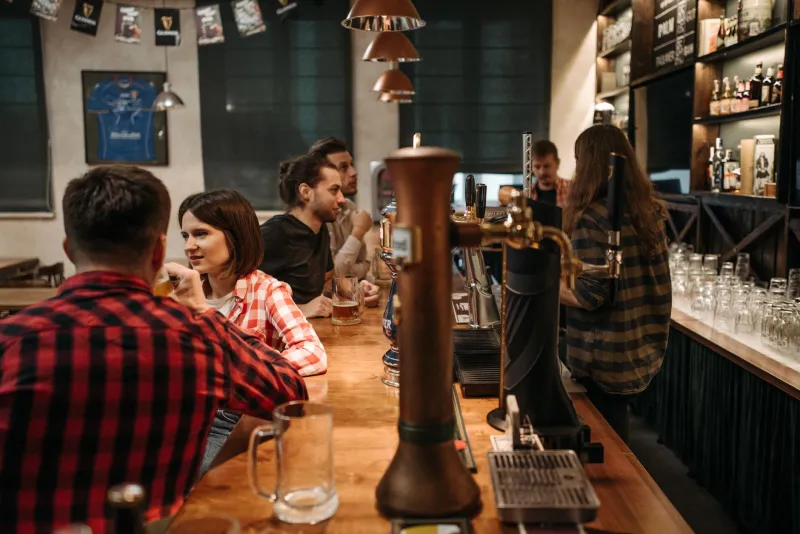
There's a woman who comes into a bar in Denver every Thursday at 7 p.m. She orders the same drink—a gin and tonic with cucumber—sits at the same spot near the service station, and talks to whoever's working. Sometimes she stays for one drink. Sometimes she stays for three. She's been doing it for almost two years.
Her name is Sandra, and she's 43, divorced, and works remotely for a tech company based in a city she's never visited. She has friends, she's quick to clarify. She has a full life. But Thursday at 7 p.m. is the part of her week that feels most like she belongs somewhere.
"It sounds sad when I say it out loud," she told me. "But it's not sad. It's the opposite of sad. It's the only hour of my week when I'm not performing for a camera or a Slack channel or a dating app. I'm just... there."
Sandra is not an outlier. She is, in the most uncomfortable way, a representative of something much larger.
The Numbers Behind the Empty Feeling
In 2023, the U.S. Surgeon General issued an advisory on loneliness that used language you don't usually see in public health documents. It called social disconnection an epidemic. It compared the health effects of chronic loneliness to smoking 15 cigarettes a day. It noted that Americans have been losing close friendships, community ties, and what sociologists call "third places"—spaces that are neither home nor work—at an accelerating rate for decades.
The data is bleak in ways that are hard to fully absorb. A 2021 survey from the Survey Center on American Life found that the share of Americans with no close friends had quadrupled since 1990. Median time spent with friends dropped sharply during the pandemic and has not recovered to pre-2020 levels. Church attendance is down. Civic organization membership is down. The bowling leagues Robert Putnam wrote about in Bowling Alone are even more depleted now than when he wrote the book.
Something has to fill that space. And increasingly, something is.
The Bar as Accidental Community Center
Sociologist Ray Oldenburg coined the "third place" concept in 1989 to describe informal gathering spots—barbershops, coffee houses, public parks—that provide social infrastructure outside of home and work. His examples feel almost nostalgic now. Many of those institutions have contracted or disappeared entirely.
Bars, for all their complicated cultural baggage, have survived. And in their survival, they've absorbed functions they weren't originally designed to serve.
"I've had conversations at my bar that I don't think those people are having anywhere else," says Marcus Webb, who tends bar at a neighborhood spot in Philadelphia's Fishtown neighborhood. "People come in and they're carrying something. Not always something heavy. Sometimes just the low-grade loneliness of a week where they didn't really connect with anyone. And they sit down, and we talk, and something shifts."
Webb is careful about how he describes his role. He's not a therapist. He doesn't want to be. But he's also not pretending that what happens at his bar is purely transactional. "Bartending at its best is a social art. You're reading the room constantly. Who needs to be drawn out, who needs to be left alone, who might click with the person two stools down. That's the job."
Psychologists who study social behavior have a name for what good bartenders do intuitively: ambient sociality. It's the low-stakes, low-commitment social contact that humans need but modern life has largely eliminated. You don't have to be anyone's friend to get it. You just have to be present somewhere that other people are also present.
Design for Connection
Some bars are no longer leaving this to chance. A growing number of venues are deliberately designing their spaces and programming to facilitate the kind of connection that used to happen organically in communities that no longer exist in the same form.
Communal tables are part of this. Long bar tops where strangers sit side by side. Games that require interaction—not just screens showing sports, but darts, shuffleboard, even tabletop games that get pulled out during slow hours. Some bars have introduced "social seating" policies: during peak hours, solo guests are seated at the bar rather than tables, creating natural proximity and conversation opportunity.
A cocktail bar in Seattle runs what it calls "Open Seat Sundays"—no reservations, no assigned seating, and a house rule that encourages guests to invite solo diners or drinkers to join their group. The owner says the policy makes some people uncomfortable at first. Most of them come back.
In Nashville, a bar called The Common Room—a name that's almost too on-the-nose—has built its entire identity around anti-isolation. No TVs. Seating arranged to face inward rather than toward walls. A weekly "Strangers Welcome" event where the cover charge is reduced for people who come alone. They've hosted weddings between couples who met there. They've been credited by more than a few regulars with pulling them out of what one described as "a really dark few months."
The Limits of the Bartender as Therapist
It would be irresponsible to write this piece without acknowledging the tension at its center. Bars are places that serve alcohol. Alcohol is a depressant. Using a bar as your primary social infrastructure when you're struggling with loneliness or mental health is a strategy with real risks attached to it.
Bartenders who take their pastoral role seriously are also the first to say this. "I can listen. I can make you feel seen for an hour," says Webb. "What I can't do is be your therapist, your best friend, and your sponsor all at once. And some people need me to be all three, and that's when I have to be honest about what I'm able to give."
The Surgeon General's report doesn't mention bars. The loneliness literature rarely does. There's a cultural hesitance to acknowledge that a drinking establishment might be filling a genuine social need, because it complicates the public health narrative around alcohol. But ignoring that reality doesn't make it less real.
The bar as third place is not a solution to the loneliness epidemic. It's a symptom of it—and sometimes a comfort within it. The honest version of this conversation holds both of those things at once.
What We Owe Each Other at Last Call
Sandra, back in Denver, doesn't think she's doing anything unusual. She's just found a place where she can be a person for an hour on Thursday evenings. The bartender knows her name. The regulars nod when she walks in. The gin and tonic tastes the same every time.
"I know it's not deep," she says. "But it's real. And right now, real is kind of hard to find."
Maybe that's the most honest thing anyone can say about what bars are becoming. Not deep. Not a replacement for the friendships and communities and institutions we've lost. But real. Present. Warm in a way that a lot of the world stopped being somewhere along the way.
That's worth something. It might even be worth showing up for.